Conservatism, Accountability, Opportunity

It’s been a week. Between Forest and a one-year-old with hand, foot and mouth (plus the looming arrival of baby number two), I’m running on fumes. Forest has me feeling particularly low about Spurs. Because here’s the thing: it came after what you could call a ‘good’ week. If you squinted hard enough, you could see tweaks, changes, signs of life. Sure, it was against poor-quality opposition, but there were glimmers: full-backs moving inside to create passing lanes (and thriving), front-four interplay and connection, Xavi Simons actually, you know, having the ball. And then Forest happened, and it felt like the absolute worst extremes of Thomas Frank’s Tottenham all at once.

Let’s start with the numbers because they tend to cut through the noise: 22 points from 16 Premier League matches. Our fewest at this stage since 2008–09. That isn’t just bad; it’s historically bad within modern Spurs context. The performances have mostly matched the data: sluggish, risk-averse, and lacking in attacking intent. One shot on target vs Forest. Which would be galling at the best of times, but becomes excruciating when set against Frank’s own pre-match KPIs: he said he expected a “front-footed, aggressive, brave and offence-minded” performance. The words sound great; the reality was the complete opposite.

And then there were the subs. Ben Davies, João Palhinha, Lucas Bergvall on for Djed Spence, Archie Gray, and Rodrigo Bentancur. The changes themselves would have raised eyebrows anyway, but Frank’s justification crystallised everything Nathan had been warning us about from day one:

“No, we had four offensive players on the pitch. I think that’s fair to say. So I felt that, just to go back to the bit before where I say we’re disjointed. So if you’re disjointed, you can have 11 offensive players on the pitch. It will not help. So we need to be in sync. And then it helps, and hopefully we can find a way back after that.”

via Alasdair Gold for Football.London

That’s it. That’s the nub. Everything, everything, is underpinned by conservatism. It’s about control, about safety, about risk-aversion, and the players respond in kind: second-guessing themselves, playing within themselves, lacking bravery at the exact moments the match demands it. The result is flat, joyless football that harms both performance, results, and identity. We’re grinding our best players down to the safest versions of themselves and, unsurprisingly, nobody looks better than they did six months ago. In fact, many look worse. You might argue Archie Gray has taken a step — fair, and he’s been good — but that owes as much to him playing in midfield and being a special talent as it does to any structural improvement under Frank.

Bentancur as the Flagbearer of the Problem

I need to talk about Bentancur because he has become, in my mind, the flagbearer for this conservatism. There was a moment in the Forest game that summed this version of Bentancur up. Playing alongside a 19-year-old who had just made a catastrophic mistake that led to a goal, the ball comes to Bentancur — enough time and space to take it down, the whole picture in front of him — and he just helps it on, like Ashley Westwood playing prime Dyche-ball. That’s not leadership. That’s not bravery. That’s not what I expect from any central midfielder at Spurs, let alone one who is amongst our most experienced players. It’s the embodiment of the fear-avoidance loop that is defining our football right now. It sucks the life out of moments that need agency and personality.

This isn’t to say Bentancur isn’t a useful footballer in certain contexts; he can be. But not as the tone-setter in this version of Spurs. And when his selection and usage align so cleanly with Frank’s justification framework — safety-first, guardrails, control — it becomes difficult not to see him as a symbol of what’s gone wrong.

The Accountability That Never Seems to Arrive

Here’s where I pivot (pun intended) away from Frank for a moment, because if we’re going to critique effectively, we must widen the lens. I am continually astonished at the lack of accountability for the people making the decisions above the Head Coach. How are Johan Lange and Fabio Paratici still in jobs?

Our squad building has been incoherent across multiple windows. We are starved of technical quality and — most importantly — passing ability. Glaring needs have gone unaddressed while we’ve doubled down on the same profile: athletic, off-the-ball stand-outs in midfield. Rodrigo Bentancur, João Palhinha, Pape Sarr, Archie Gray. You could even throw Lucas Bergvall in there, though he’s young enough to grow. What we haven’t prioritised is press resistance, progressive passing, or genuine creativity. None of these players are defined by their passing.

These aren’t coaching quirks. They’re structural failures at director level.

And Paratici’s situation remains extraordinary. He was banned from football following an investigation into financial irregularities, as widely reported in Italy. He later returned to a role at Spurs after a plea bargain was accepted — under Italian law, this does not require an admission of guilt. The club can point to that technicality, but the reality is that a senior executive was involved in a major controversy, sanctioned by the sport’s authorities, and reinstated without any detailed explanation to supporters. For me, that feels less like governance and more like a statement of values. Is his Rolodex really that important?

Those values speak to an absence of consequences. When bad decisions carry no cost, mediocrity perpetuates itself. Recruitment misfires? Keep your job. Repeated managerial appointments that tank? Keep your job. Structural incoherence? Keep your job. Alleged criminality? Welcome back. At Spurs, failure isn’t punished — it’s institutionalised.

Accountability is the bedrock of elite performance, and we don’t have it. Until that changes, everything else — analytics, academy pathways, tactical philosophy — is cosmetic.

The Paradox: We’re a Financial Titan in a Rigged Game

Now here comes the maddening part: the game is rigged in our favour. We are a financial titan. The stadium, the matchday revenues, the commercial footprint, the global brand — we have the capacity to outspend not just most of the league, but most of Europe. We don’t even need to do things particularly well to get back to where we were under Mauricio Pochettino. Spend big, spend smart-ish, and the tide just… lifts you. Look at Arsenal (ugh, I know, but we do have to): they were a punchline not long ago, but money plus a credible plan plus a willingness to clear out and re-invest changed their trajectory rapidly. We could copy-paste 60–70% of that model tomorrow and improve almost by osmosis.  

Of course, I want us to be more sophisticated than “just spend”. But it’s important to acknowledge reality: if you have more money than most and the league rewards scale, you can brute-force your way back to competence. Sustained trophy wins require more, but top-four consistency is squarely within reach if we simply choose to act like an extremely wealthy club.

Competitive Advantage

So what’s the alternative? If we want more than brute force spending — if we want a durable edge — we have to invest. And the clearest path is, still — even after all these years of discussing it — data and analytics. Not a couple of analysts buried in recruitment, but the biggest, best-resourced analytics department in world football. Be ambitious. A proper, multi-disciplinary decision-science unit that touches everything:

Recruitment

  • Identify players smarter and faster than anyone else. Use predictive models. Combine different approaches for reliability. Feed them with everything: match stats, movement tracking, biomechanics, injury risk, tactical fit simulations.
  • Create catalogues of player types matched to the demands of our system. For example, an inverted full-back archetype might require press resistance, short passing under pressure, and spatial awareness. This lets us check instantly if a target fits the role and even forecast how they’d perform under a different coach, so we stop building squads that collapse when managers change. I’m sure we already do this, but the implementation is visibly off. Hold leadership accountable.

Performance & Tactics

  • Live match modelling tracks what coaches currently rely on instinct for: player energy, spacing between lines, passing lanes, pressing cohesion, and risk–reward trade-offs in build-up. It can then recommend real-time tweaks: widen the pitch, adjust pressing triggers, or make a substitution that maximises attacking threat without leaving us exposed. This is proactive, data-driven coaching and doesn’t just rely on the fact that Matt Wells has a knack for this shit.

Medical & Load Management

  • Predictive injury models combine training data, match intensity, and historical patterns. Instead of a crude red/amber/green fitness rating, produce scenario plans: how many minutes at what intensity should a returning player play? How does that affect pressing? When is an extra 10 minutes worth the future risk? These decisions should be evidence-based.

Academy Pathways

  • Give every academy player a personalised dashboard with clear targets for their role: first touch under pressure, scanning frequency, acceleration over 5–10 metres, aerial duel technique, decision-making speed in tight spaces. Track progress weekly. These dashboards don’t just inform coaching; they roll up into leadership KPIs. If a player hits pathway milestones, that success belongs in the performance review of the people running football operations. Progression of academy players into meaningful first-team minutes should be a core KPI for football leadership. If youth integration is our stated strategy, then measure it — and reward or penalise accordingly.

Hire 40–60 specialists across data engineering, machine learning, performance analysis, tactical modelling, sports science, and UX design for coaches and players. Fund them properly. Give them access. Then measure impact every year: recruitment hit rates, injury reduction, pressing stability, academy conversion, resale value uplift.

Individual Coaches for Every Academy Player

We have an incredible training centre and we should be leveraging it. One individual coach per academy player isn’t excess. Each player gets a dedicated pathway coach responsible for technical and physical development.

  • Technical: first touch on the move, directional first touch, receiving under pressure, weak-foot competency, manipulation of tempo. All the things you hear people like Harry Brooks (specialists actually doing the work with Premier League players) talk about.
  • Physical development: movement mechanics, acceleration, deceleration, hip-load management, core strength patterns — tailored to role demands.

Meanwhile tactical and psychological are taught collectively:

  • Tactical literacy: role principles in our model and two adjacent models (because coaches change); what your responsibilities are in each phase; how to recognise common opposition solutions.
  • Mental skills: situational resilience, error-recovery routines, leadership behaviours, communication in pressing structures.

The assigned coach also aligns with loan managers to ensure the role-profile matches the player’s pathway; we stop sending dynamic, modern attacking midfielders to teams that demand traditional chalk-on-boots wingers for 90 minutes of low-touch slog-fests.

The goal is twofold:

  1. Make academy contribution a consistent pipeline to the first team.
  2. If a player’s ceiling is below our threshold, increase their market value through demonstrable progress and clarity of role. Either outcome benefits the club.

What Needs to Change

So what does fixing this look like in practice?

  1. Clarity of Football Philosophy. The Head Coach is a custodian of principles. If they leave, the football doesn’t collapse. Our recent history has been a pendulum swing of ideas; stop the swing. Pick the principles and stick to them.
  2. Accountability in Football Operations. Evaluate Lange and Paratici against clear performance metrics: squad construction coherence, recruitment hit rate, wage bill efficiency, and alignment with the stated principles. Include academy progression as a KPI alongside recruitment hit rate and wage efficiency. If they fail, change personnel. After years of drift, continuing as-is is unjustifiable.
  3. Spend with Role Integrity. We’re a financial titan in a rigged game. Use that to our advantage. But buy role profiles that fit the style, not simply names that Fabio recommends. If the model says we need a press-resistant six and a right-sided 1v1 winger, deliver that — not “nearest available player with vibes.”
  4. Empower an Analytics Department. Make it the biggest in world football. Integrate, don’t silo. Get the data out of slide decks and into coaching sessions, into recovery plans, into academy drills, into boardroom decisions.
  5. Create Opportunities for Young Players. Don’t wait for crises to hand opportunities to academy talent. Use them because their profiles suit the role. Pick them in functioning teams, not reserve-team mash-ups. Give minutes with purpose.

Back to Forest, and Why This Matters

Frank’s explanation of the subs is the system talking. It says: we value control more than risk. We’d rather avoid disorganisation than chase momentum. But football at the top level requires courage at the right moments and coherent structures that enable it. One shot on target is not a tactical footnote; it’s a culture problem. It’s the manifestation of a safety-first ideology that leans away from expression. And it’s why our best players look worse. Players need permission to be the best versions of themselves. Systems can constrain or unleash. Ours constrains.

When your environment is telling you to play within yourself, you play within yourself. And when the flagbearers of the environment are your senior players, conservatism becomes self-reinforcing. That’s how you end up with Rodrigo fucking Bentancur flicking the ball aimlessly into space instead of taking responsibility. That’s how your “front-footed, aggressive, brave” becomes one shot on target.

Frank’s philosophy isn’t changing overnight, which means he’s probably doomed to fail. Now it’s up to the c-suite to ensure this doesn’t happen again — to stop hiring coaches whose principles don’t align and to build a structure that outlives any one man

It Doesn’t Have to Be Like This

We don’t need perfection. The game is rigged in our favour. But if we choose to be deliberate — to build the world’s strongest analytics department, to fund individual coaching for academy players, to impose clarity on football operations — we can be better than just “rich enough to be fine.”

Look, I’m an amateur blogger with no inside track beyond what we all read and what I know from my own professional life in director-level operations, and I’m making this sound easy. I know it’s not. But we are rich enough to hire the very best and make it look easier than it currently appears.

And yes, I know this sounds like football-by-spreadsheet. It isn’t. It’s football with better information. The human element must always be central — bravery, leadership, creativity — but supported by evidence so we stop guessing and start optimising.

So, yes, I’m low after Forest. I’m exasperated by Frank’s conservatism. I’m tired of watching players second-guess themselves. But I also look at what Spurs could be — with money, with infrastructure, with a talent pipeline — and I see a path back. Spending gets us to competence quickly. Intelligence gets us past competence sustainably.

Here’s to 2026. COYS.
In/Out

This week has seen two really good articles published in defence of Ange Postecoglou:

These are two excellent contributors on Spurs, and I really enjoyed both of these pieces.

In summary, here’s where I am right now:

  • The recruitment in summer 2024 was totally insufficient. We made some really good signings for the future (good) and one signing for the present (bad). I know that we tried to sign Conor Gallagher, Eberechi Eze, Pedro Neto and João Gomes. None of those attempts worked out and so, instead, we signed no midfielder and no 1v1 wide specialist. We were and are left with major weak points in our squad depth.
  • Similarly, we have been slow to act in the January transfer window, despite Postecoglou near enough begging for reinforcements. I have several contacts who have a pessimistic view on whether Spurs will do any business in the remaining days of the window. This is, in my view, negligent.
  • Postecoglou has been really unlucky to be without a bunch of players from knocks, twists, viruses, etc.
  • Postecoglou has been really unlucky that Rodrigo Bentancur made a racist comment.

Postecoglou has been dealt a tough hand, and our pre-season hopes of top four and a trophy were wildly optimistic. But the reason I wrote back in December that I had lost faith, and continue to feel this way, are about long-term sustainability, some of which I mention here but to summarise.

  • Injuries.
  • Management of squad in light of injuries.
  • Use of young players (especially in light of lack of depth).
  • Tactical struggles.

When I’ve spoken about the injuries/squad management and young players, I tend to receive push-back. But often that push-back misunderstands the points I’ve made, probably due to my lack of eloquence, so I thought I’d delve a little deeper. I might touch on the tactical struggles in a later article, but essentially my view is that several of the Premier League managers have found ‘solutions’ to our build-up, that I have yet to see Posteoglou able to counter.

The injury situation has been covered in immense detail at this point, and Postecoglou actually got very defensive about this in his pre-Leicester press conference, saying:

We’ve just got injuries, and you can do a million investigations and talk to anonymous sources. You don’t need to talk to anonymous sources, you can talk to me, every decision that is made is from me. I am responsible for this, if you want a head on a stick, take mine, but I am absolutely 100 per cent confident that we are in a better place as a football club today than when I started.

Presser points | Spurs vs Leicester City | Ange Postecoglou, 24 January 2025

That was is in response to The Athletic’s piece by Jay Harris and Jack Pitt-Brooke, published 23 January 2025, which analysed the injury situation in some detail. I strongly recommend reading it. This followed a lot of publicity around Anton McElhone’s must-listen interview on The Monday Night Club, which is referenced in the piece by Jay and Jack.

Even just a surface level analysis tells you that last season, at the turn of the year in 2023/24, we ended up playing a centre-back pairing of Emerson Royal and Ben Davies and having a bunch of kids on the bench because Cristian Romero, James Maddison, Ivan Perisic, Ryan Sessegnon, Manor Solomon, Rodrigo Bentancur and Micky van de Ven were all out injured.

The same has happened this year. The same thing happened at Celtic. According to The Athletic’s piece, the same thing happened at Postecoglou’s other clubs.

I think at this point it is beyond doubt that Postecoglou’s style, at least initially, leads to a disproportionate number of injuries: Ange has told us, Anton McElhone has told us, his previous clubs’ injury records tells us, our current and last year’s injury list tells us. Does this mean that Postecoglou’s style is wrong and bad? Of course not! High pressing is, I think, almost essential at this point. And high pressing with an intensity that the rest of the league simply cannot cope with is something I have wanted since Mauricio Pochettino left.

The point I repeatedly make is not about the style and not even about the number of hamstring injuries. It’s this: knowing what he knows (and he does know, he’s said so) about the impact of his style, knowing what happened last season specifically, knowing the size of the squad this season… where have the mitigations been? Where have been the attempts to integrate more players to add depth?

Anonymous sources claim that Geoff Scott left after ‘the pair fell out over how to manage the first-team squad’s workload and the recovery of injured players’. Anonymous sources claim that ‘the medical staff had reservations about [Micky] Van de Ven’s readiness to play against Chelsea. In the lead-up to that game, Postecoglou also spoke about his readiness. For context, the game was on the 8th December.

He’s due to have his last couple of sessions with the rehab guys today [4th] and tomorrow [5th], so we’re hoping back in terms of training potentially by Friday [6th], at the very latest early next week [w/c 9th] if everything goes well.

Team news | Ange’s latest on Romero, 4 December 2024

He hadn’t even returned to full training, let alone built up fitness. Postecoglou potentially wasn’t expecting him back until the Monday after the game. He started and went off injured with a muscular injury. Wilson Odobert and Richarlison both broke down with injury soon after returning from injury (very soon in Odobert’s case).

The club is in the process of changing a bunch of its medical staff (again!), which has led some to speculate that the recovery of players is not being managed effectively. Meanwhile, Anton McElhone confirmed that when assessing whether a recovering player can play/how much they can play, Postecoglou is given the risk factor numbers/insights from the sports science teams and makes the final call about whether a player plays or not. I don’t think this is unusual — it’s certainly consistent with what we saw under José Mourinho on All Or Nothing. Remember him fighting with Geoff Scott for Son Heung-min to play with a broken arm? From a contact I have working in sports science in football, I know that it is common for sports science and medical staff to feel under-valued, ignored and often overridden. It is not like in US sports, where, from my basic understanding, what the medics say goes. But this is not a Postecoglou issue, it is much, much wider within football.

Anyway, unlike the injury cause, the stuff on injury prevention all speculative, and so I won’t dwell on it. I do wonder, though, whether a generally more cautious approach — as we saw very early on in Postecoglou’s tenure, when he insisted Cristian Romero come off after suffering a head injury — might have helped. Obviously concussion protocols are a little different, but I found that moment encouraging.

Two of the other mitigations I’ve highlighted have been rotation (discussed here), and the use of young players. I know I bang on about the use of young players constantly. But that’s because 1. it’s literally our stated club strategy to bring through Academy players, and so he will be judged on it, 2. UEFA regulations mean that having club-trained players is extremely helpful and 3. they’re good; we won the lot last year! Will Lankshear was Player of the Year in the PL2. Here’s some information on what previous PL2 POTY winners have done the season after their award.

You might think that none of our young players are ready, and I think that is a completely legitimate view to have. My view is that young players who’ve excelled in Under-21 football need to be playing regular men’s football, be that at Spurs or out on loan. Given all of the above and the seeming inevitability of injuries hitting, I think it was foolish of Postecoglou not to integrate a few more young players to have avoided the situation we’re currently in with a bunch of untested teenagers on the bench literally just keeping seats warm whilst we fail to use our allotted substitutions on a week-to-week basis, meaning players play 90 after 90 after 90.

I first raised this last year when James Maddison was injured, and we were moving players around and essentially playing without any creative passing ability, whilst Jamie Donley (who was excelling in the Under-21s at the time) sat on the bench unused. To not give Donley a few minutes here and there to test his readiness felt stubborn to me — why have him on the bench and not use him? His really excellent performances in the summer pre-season tour hammered home to me that he could have made a difference.

One of my arguments has been that rather than running Pedro Porro, Dejan Kulusevski, and Dominic Solanke into the ground and watching their form plummet and injury risk heightened (these three in particular, though the same happened to Destiny Udogie, potentially leading to injury), we might have used another player (in Porro’s case either Sergio Reguilón or a Development Squad player) to relieve them for a match or two, so that hopefully they returned stronger, fitter, sharper and performed better. During that period, naturally, you would expect a slight overall drop-off, as you’re bringing in a weaker player. But it’s not a drop-off from Pedro Porro to whoever, it’s a drop-off from this Pedro Porro to whoever.

I made the point on The Extra Inch (Spurs Podcast) that whilst we were losing most matches anyway it seemed even more logical to take the hit to try to then actually win future games. People took that to mean that I was using hindsight — ‘well, we lost, so we might as well have used younger players’. I was saying (in advance of the games, knowing the form of our tired players!) that using a risk-based approach, utilising younger players as depth to allow tired players to rest, we were reducing the risk of injury plus hopefully increasing the chance of winning future matches. I.e. if you look at results over a block of, say, ten games, you might benefit more than taking each game as it comes and playing your “strongest” available team.

People argue — and I’m pretty sure Postecoglou himself has done so — that bringing young players in during a crisis can be detrimental to their development. I think this is used as an excuse not to trust young players. It is completely player dependent. Some of our first team players have struggled during this period, whereas three of the younger, less experienced players — Archie Gray, Djed Spence and Lucas Bergvall — have stepped up and shone. It’s about knowing your players and their characters. If someone lacks self-confidence of what football call ‘personality’, then it would definitely be a risk to throw them into the deep end. But Mikey Moore, for example, looks fearless right now, and that fearlessness is not unique to Moore and could be extremely useful during the tough times.

Everything feels quite bleak at the moment, but my over-arching view on all things Spurs is one of positivity. We’ve had a major restructure of the recruitment and analytics departments culminating in some good signings for the future, we have started paying our young players market rate and we have some gems in the academy (even beyond Mikey Moore). In June 2023 Daniel Levy told the Fan Advisory Board open meeting:

We made a conscious decision that we wanted a coach who would understand what we really wanted as a Club, which was to play attacking football, to enable everyone to enjoy coming to a match and be entertained, and also someone who understood the importance of the Academy.

Daniel Levy, Fan Advisory Board meeting, 9 June 2023 (Reported on tottenhamhotspur.com)

That is ‘The Project’. I mean, if you want my actual view on what The Project is, there is no ‘project’, but fans like to refer to one — maybe because it is easier to compartmentalise this stuff from previous poor decisions which seemed to veer away from the club’s strategy.

Essentially Ange Postecoglou is a part of, hopefully, achieving the club’s strategic goals — success on the pitch whilst playing entertaining football and utilising home-grown players. If he doesn’t achieve these things, then the club will move on to another, similarly progressive Head Coach in the hope that they will. I think it’s that simple, and so I am pretty comfortable with the idea of moving on from Postecoglou (at some unknown point), even given previous poor appointments — I have faith we’ve learned our lessons, and have better people involved in the selection process now.

Why I’ve (Temporarily?) Lost Faith In Angeball & Why I Still Wouldn’t Want Him Sacked

Once again we find ourselves divided as a fanbase. It’s no surprise given the way the season has gone to date: seven wins, two draws and eight defeats in the league. Swinging from a low point amongst several other low points in Ipswich at home to a swashbuckling win against the reigning champions, to smashing Southampton and beating Manchester United to conceding six at home.

When we’re good, we’re really good. How often has that been? It depends who you ask. When we’re bad, we’re wide open, and sometimes we are creatively stifled. How often has that been? It depends who you ask.

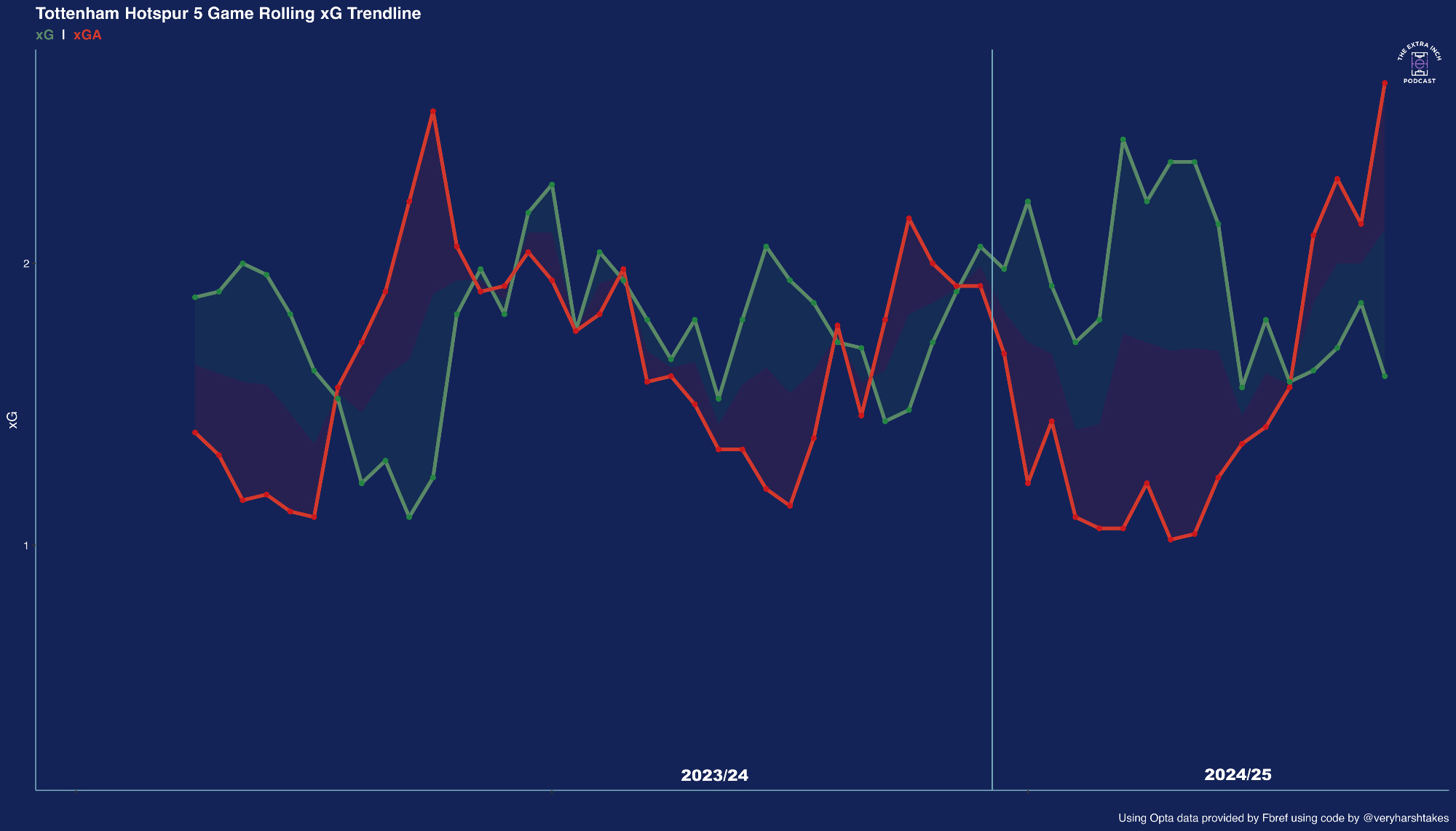
Below is Nathan A Clark’s 5 Game Rolling xG Trendline for The Extra Inch (Spurs Podcast).

Tottenham Hotspur 5 Game Rolling xG Trendline

This is the third time under Ange Postecoglou that we’ve seen expected goals against rocket up and expected goals for drop at the same time, the two most notable periods being when our centre-backs have been injured. More on that later.

There is a core group of fans that never took to Ange. They sneered at him — an Australian who was best known for winning in Scotland. Double whammy on the football fan snob-o-meter. They were always going to look for the first signs of all not being well and double down. He’s too naive. He doesn’t have the experience of managing a club at this level. He’s not used to facing credible opposition every week.

I think there’s also the opposite — those that will absolve Ange of any and all responsibility when things don’t go well because 1. they like him (boy is he likeable), 2. it’s a ‘project’ (more on that later too), 3. look what happened when Mikel Arteta was given time. How can Ange possibly have been expected to do more given the squad he has been given, the injuries he’s had to deal with, and the total rebuild required?

And I land somewhere in the middle right now. I expected — I think quite reasonably — more progress in year two.

I think the summer transfer window dealt him a pretty rough hand — not enough players for now, not even close to all squad depth being solved, and especially no 1v1 wide specialist, instead a renewal of Timo Werner’s loan. I said all this at the time, for the record, and you’ve likely seen my articles about addressing squad needs. But this has also been a season of unforced error after unforced error from Ange.

In my opinion that has included a style of rotation that doesn’t really work for anyone (what I refer to as ‘Team A’ and ‘Team B’ style – meaning youngsters play with other youngsters and ‘squad players’ rather than the rest of the ‘first XI’), to repeatedly bringing back players early from injury only for them to re-injure themselves, to a, let’s say, ‘restrained’ use of substitutions and some extremely poor in-game management.

My view on rotation is that the dream scenario is to have a squad where each player can be rotated out in a way that allows them to be suitably rested (particularly when your club is involved in European competition), and that the incoming player(s) won’t create a significant drop-off when part of a greater collective. That means that in every game you can be rotating one, two, maybe even three players. Liverpool have done this for years. City do it. Yes, I appreciate they have deeper squads. Our rotation this season largely sees us make six or more changes for the competitions which seemingly are less important to us, meaning that the incoming players never really get to experience being part of an otherwise full-strength team. It means that they are then not trusted to be a part of that team until the injury crisis means there’s no other choice — hence Djed Spence, Lucas Bergvall, Archie Gray only now getting regular Premier League minutes. It has created a situation where we only have eleven, twelve, maybe thirteen players that are genuinely considered ‘first team’. The players who have played the most minutes (Pedro Porro 1,888, Dejan Kulusevski 1,784, Dominic Solanke 1,747 and Destiny Udogie 1,685) are the players that visibly appear the most tired and whose tiredness also seems to impact us. In the games where Solanke has been less intense, our press has suffered. When Kulusevski is tired, he wins fewer duels. When Udogie and Porro are tired, it’s noticeable how much our ball progression from deep drops off.

We clearly lack depth in some positions (centre-back and passy number ten being the obvious two) but we have some areas of the pitch where I think constant, regular rotation would have worked — Gray and Spence at full-back, plenty of midfield options (albeit not a decent number six rotation, though that appears to be through choice), plenty of wide options. The impact of not readying players to step in is that when the injuries have come, we’ve suffered. And those injuries have really come.

The recent case of both Cristian Romero and Micky Van de Ven returning from injury early and exacerbating their injury issues immediately is in addition to Wilson Odobert and Richarlsion having done the same. The argument goes that Ange ‘cannot be blamed’ for Romero re-injuring himself since it was a different injury. It feels to me too curious a coincidence that he returned extremely quickly — acknowledged by Ange — having not had the additional training sessions (and, therefore, strength and conditioning sessions) to build up his sharpness and resilience, only to go down with a muscular injury, like so many others. I can’t really get my head around how this has been allowed to happen. Players should not simply be able to dictate their returns, nor should injury crises impact on an individual player’s readiness to play after injury. But our injury situation more broadly is just as concerning. Ange has accepted that injuries are just sort of baked into the style of football and intensity of training, saying:

The nature of the way we train and play is always going to be on the edge, it’s kind of by design which means you can have some attrition but the ones we’ve had this year for the most part like Richy and Wilson are just a consequence of the way we train and play and players just not being ready for it.

Ange Postecoglou explains what he told Cristian Romero after Tottenham and Argentina injury problem – Football.London

With the thinness of our squad and number of games, surely we needed to factor this in to training and intensity of play and build up more slowly? If Ange has seen this happen at previous clubs, I wonder why he has not adapted and, instead, just powered through with an insistence that players will either adapt and become mainstays, or saunter off to new clubs, their bodies somewhat broken and inadequate. This, to me, feels at odds with an otherwise modern and progressive style.

This ties in to what I perceive as a prioritisation of physical prowess over technical mastery. Our squad really lacks technical excellence, pretty much all over the pitch. We have a subset of players who I would say display plus-level technical skillsets over and above the competition in their positions across the league: Pedro Porro, Cristian Romero, James Maddison, Micky Van de Ven and Dejan Kulusevski (the final two both in terms of ball mastery and comfort in possession rather than passing). The lack of genuine passing ability elsewhere in the squad means that when we don’t have the likes of Romero and Maddison in the team, we really lack the ability to progress the ball and find creative passes, meaning we rely heavily on chance creation from winning the ball back with our pressing. Which works really well when teams come out to play against us — boy have we seen us punish some of those — but less so when teams sit deep and allow us to have the ball.

I think the signing of Radu Drăgușin needs to be viewed through this lens too. He is undoubtedly a physical phenom with incredible strength and neck muscles and decent recovery pace yet he is, in my view, a totally inadequate profile fit for the style of football we are trying to play. Ryan Gravenberch revealed after the 6-3 home defeat to Liverpool that they targeted Drăgușin — though frankly we needn’t have waited for the confirmation, it was evident through the eye test as it has been several times before.

Yeah we had a really good game plan, we wanted to keep them on the right side and press the right centre-back. Sometimes it went well and sometimes they did it good but by the end, I think we did really well.

Liverpool star reveals attack was focussed on one Tottenham man in brutal 6-3 pasting – Football 365

I appreciate that we needed to sign a centre-back urgently last January, but Ange signing off on Drăgușin to me seems really bizarre. In my opinion, he is going to need replacing within the next two windows and maybe we luck out and that’s Luka Vuskovic (or Ashley Phillips — unlikely in my view from a technical perspective — or Alfie Dorrington — unlikely in my view from a body-being-able-to-cope-with-Angeball perspective).

So my biggest gripe at the moment is that in order to see the fruits of Angeball we seem to require the perfect player in every role. If one is missing, we don’t click. Without a 1v1 winger on one side and a shot-heavy, back-post arriving winger on the other, we don’t maximise our chance conversion. Without a transitional eight we get caught often on the counter. Without a passing midfielder we lack the ability to break down a set defence. Without ball-playing centre-backs and a press-resistant six, our progression suffers. I think this has been heavily impacted by our player recruitment and our style of rotation — had we greater depth and/or more players used to playing with nine or ten of the ‘first XI’, the consequences of inevitably missing players would be felt less keenly. As it is, we suffer a terrible drop-off with a handful of injuries. And given that injuries are seemingly just a part of the process, it’s hamstringing (pun intended) us significantly.

One of my other most common complaints this season is how passive Ange has been in terms of his in-game management. So many times it feels to me that the momentum of a match has switched against us, and we need to change something in order to re-gain it. Fresh legs, a tactical tweak, something. I wait, and I wait, and a goal goes in, and I wait some more and then maybe he’ll make a like-for-like change. That’s how it feels, at least. Some people argue that this is a long-term strategy designed to encourage the players to find solutions on the pitch. I just can’t buy into the theory that a Premier League manager would deliberately risk dropping points for a potential future gain that may or may not materialise, particularly with the knowledge of having a trigger-happy owner standing over him.

It feels as though multiple teams have found multiple ways of stopping us playing and that we have little answer for it. When we have come up against competent tacticians — Thomas Frank, Kieran McKenna, Andoni Iraola — we have lost out. The main method has been to allow our centre-backs to have the ball and block the passing lanes into midfield, thus forcing us into either low percentage or high risk passes.

And yet, despite all of my complaints, the reason I wouldn’t be thinking about sacking Ange is two-fold. I don’t want us to rush the next appointment — maybe the grass isn’t greener. And, in the meantime, I think the principles that Ange is instilling are and should be the sorts of principles our next coach instils anyway. Playing out from the back. Pressing intensely. Possession-based play. Plus — you know — maybe it will click! Maybe we’ll have the right players available, maybe we’ll be injury-free.

That doesn’t mean to say that I think we should endure unfettered suffering (yes this is hyperbole) because of a ‘project’. Ange is part of a bigger project, not the project itself. The project — as I see it — is transitioning to becoming a team that plays modern, progressive football whilst developing young players, challenging for trophies and qualifying for Europe on a season by season basis. Ange is a means of achieving that (and I think it’s fair to say that he is achieving aspects of it – the principles identified above, certainly). If he were to win a trophy this season, for example, for me that buys him another year. But if the Rolling xG Trendline continues to be objectively bad, that cannot just continue indefinitely. There have to be tangible improvements. Hopefully that will happen when players get back from injury, and hopefully we don’t suffer another injury crisis. Hopefully we’ll strengthen in January. Hopefully we’ll find tactical solutions to the problems we’re struggling with. But I just worry that too many stars need to align for this to pan out well. I really hope I’m wrong.

The development of young players is both club strategy and makes smart business sense. On paper, Ange has objectively done a pretty good job of giving minutes to young prospects this season (Gray 1,137, Bergvall 525, Moore 288, Lankshear 135). I think the first three have become genuine options, but obviously especially Gray. I would add, though, that my earlier point about rotation does impact youth development. For example, Lankshear’s only two starts came in teams alongside Gray, Bergvall, Moore (and Werner) vs Ferencvaros and Gray, Bergvall (and Forster, Drăgușin, Davies) vs Galatasaray. If Lankshear is to be given a platform to succeed and the chance to be fully trusted as a first team squad member (which, remember, is why he was not sent on loan this season) then he would be best used amongst an otherwise ‘full strength’ (or close to) XI in my opinion.

The only reasons for firing Ange at this point, as far as I see it, would be if we were at risk of relegation (at 11 points ahead of the bottom three I’d like to think that wouldn’t be an issue) or a reoccurrence of bringing back a player from injury too soon. I don’t think we should persist with a coach who doesn’t learn lessons and continuously puts our players at risk of injury. Aside from that, I think he should be safe for the rest of the season. And hopefully we will manage to win a trophy!

Many people will be reading this thinking it’s too short-termist, not thinking of the bigger picture, being overly critical of Ange given the squad at his disposal. I know that, because we regularly receive those emails to The Extra Inch inbox. I am definitely sympathetic to these arguments, but I hope I’ve addressed above why I don’t accept them. I think even given the players at his disposal, we should be doing better. I think the bigger picture, the long-term is bigger than Ange.

I’m writing this ahead of the Nottingham Forest game. I’m not feeling confident. A win for them would take them 11 points ahead of us. We’d be unlikely to turn that around, I think. It’s really important that we win this game.

Thinking Ahead

I’ve written quite a bit over the past few months about our squad building: Summer 2024 Squad Planning – Update (July 2024) and More Needed (August 2024). I think we need to update this now that we’ve seen how the squad is shaping up so far this season.

I had already mentioned in both of those pieces the transition of Dejan Kulusevski to a central player. That transition is complete, and he has barely played wide at all. In addition, he has played *with* James Maddison, not as a rotation. And I think that combination is what has led to our attacking output taking a leap. I think that changes our needs fairly significantly.

I talked in the summer piece about the midfield links (Conor Gallagher, Jacob Ramsey, João Gomes). I don’t know whether Kulusevski’s total transition came as a result of having failed to land any of these targets, or whether they were always meant to add depth to the dual eights of Maddison and Kulusevski. I would include Eberechi Eze in this cluster of links and would not be surprised if Spurs were to go back in for him. However, my instinct is for us to sign another right sided player who can also play in-field, like Kulusevski, as opposed to a left-sided player who can also play in-field like Eze. That is because our right-wing cover is Brennan Johnson and no-one if Kulusevski is playing inside. It has been clear so far that Wilson Odobert looks more comfortable on the left, and the same is certainly the case for Mikey Moore — the angles suit him far better — and Werner has really struggled when played out on the right, as was the case for Son Heung-min and Richarlison before.

The other option is to roll with the midfield options – assume that Pape Matar Sarr, Lucas Bergvall and Archie Gray can cover those roles between them (and pray Maddison and Kulusevski stay fit) and sign a right-winger. There are good options out there — my favourite is Brian Mbeumo (who can also play up-front), my second favourite is Antoine Semenyo (who can also play on the left). There are strong arguments for and against each of these options, and really it comes down to who Ange trusts and how much business we are willing to do. Think about how we would cope without Maddison or Kulusevski, and think about how we would cope without Johnson — which feels the easiest to power through? I think we need some cover for Maddison’s vision and passing ability whichever way we decide to go.

I think we also need to prioritise a left-sided centre-back, but whereas before I ideally wanted us to target one who can also play some left-back, I actually feel really quite happy with the options of Djed Spence and Archie Gray for full-back cover on both sides. I still think someone like Rayan Aït-Nouri would elevate us, but I think we can cope with what we have at full-back, at least for this season. But were we to lose Micky van de Ven for any length of time I would be hugely concerned. I have been quite up-front that I don’t think Radu Drăgușin is there with his in-possession game, albeit he’s a really strong box defender. But that weakness is exacerbated when he’s on the left.

Our build-up game is the best in the league and arguably the main reason why we function. Much is made of centre-backs being able to play a bit of football these days. In Ange-ball it goes beyond that — it’s a fundamental part of the role. Just as being able to mark, knowing when to challenge and when to drop-off, holding an off-side line, etc, are key facets of being a centre-back, in our system so is being comfortable receiving the ball and having the technical quality and problem-solving ability to play out when pressed. We don’t need another Cristian Romero level creative passer — if that player even exists — but we need someone with high levels of composure and comfort with the ball at their feet.

The other positions of need over the next two windows are: goalkeeper and number six. Both may have to wait until an obvious candidate becomes available.

Managing squads is hard, folks! Fortunately, our Academy might have some additional solutions for us over the next couple of years.

More Needed

The window has been okay but I think we need more before it closes in order to challenge for trophies.

Broadly I am happy with our recruitment and I like the players that have come in. It was always going to be challenging to sell as many players as we needed to *and* fill the squad holes which have been dogging us since Ange Postecoglou’s arrival. The errors of previous windows have taken some serious work to undo. It’s been a valiant attempt, but to my mind four significant holes still exist: back-up goalkeeper, left centre-back, left back and number six. I also think our wide options could have been enhanced differently.

I think Wilson Odobert is a really promising player. My reading of the situation is that we tried to sign some more ‘first team ready’ wingers (including Pedro Neto) before moving down the list and landing on him. I really, really like him as a player and think between him and Mikey Moore, we’re pretty well future-proofed. But I do think his signing makes the early loan of Timo Werner questionable. What we really need in the squad is players that specialise in one-vs-ones in wide areas. Werner is arguably closer in profile to Brennan Johnson and Son Heung-min. Replace Werner with, say, Brajan Gruda (who Brighton signed for £25m) and suddenly the squad seems more well-rounded in its skillset.

I like Werner, but I think we rushed into that one and it is probably not the best use of a squad space.

What if we sign more?

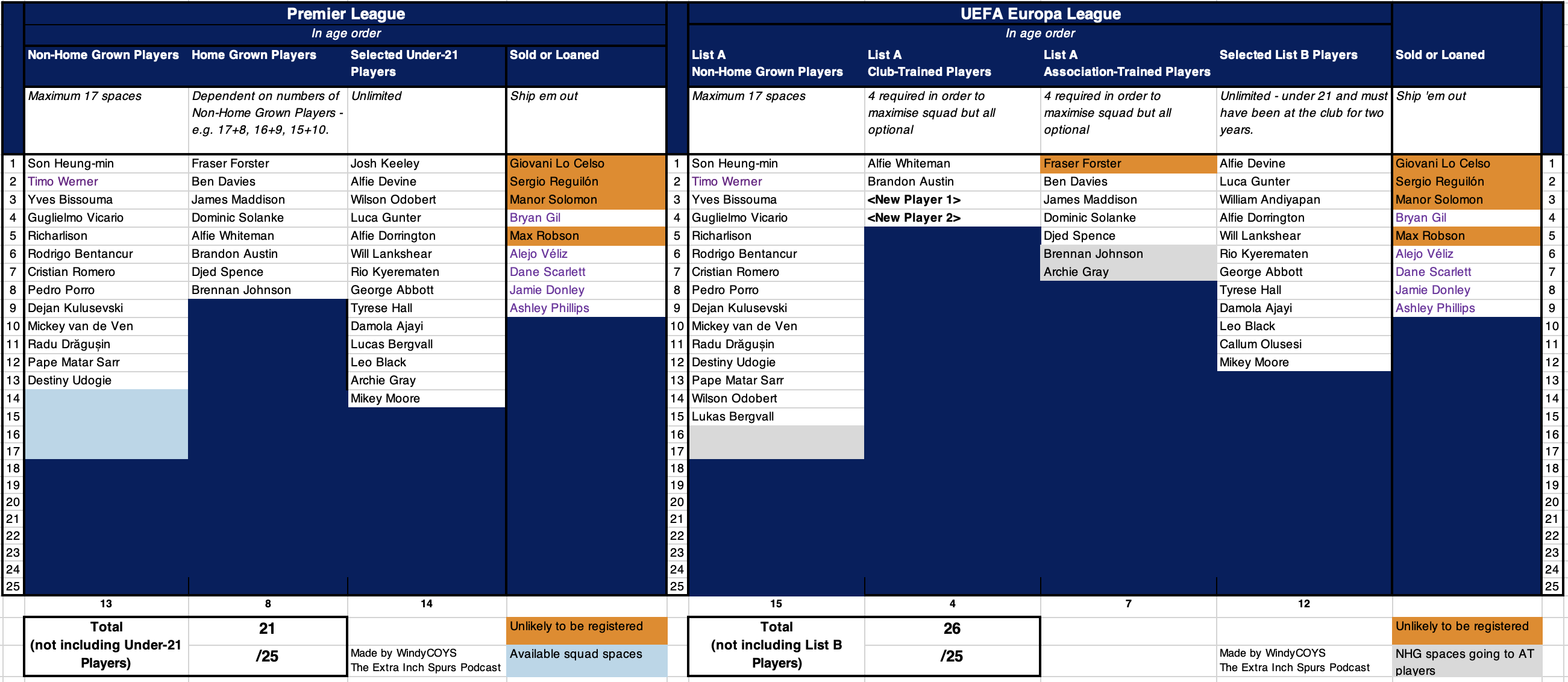
As it stands, we’re probably not naming Fraser Forster in our Europa League squad. Any more signings and we need to pick another player to miss out. I think that could be Ben Davies.

Gray’s flexibility

People like to throw around the idea of Archie Gray playing as a number six to solve that particular problem and I think that’s pretty reasonable since that was a position he was used in in pre-season, and he did play a handful of matches at six for Leeds last season (albeit in a double pivot, not a single pivot). But I think (currently at least), it’s a poor profile fit for him. And I’d also like to point out that it is largely a position that is new to him.

Perhaps the club see him as a six in the long-term, but I think if they do it’s either hopium — because the six market is bad — or just banking on his versatility. Which, you know, he’s hella versatile so may not be the worst thing.

I think Gray is an exceptional young player and will do a good job there if asked. Against teams we’ve got camped he’ll be absolutely fine. For example, had he played against Leicester, I’ve no doubt that his passing would have been more crisp and ambitious that Rodrigo Bentancur’s; he’s naturally more keen to play forward and to slide the ball through gaps to more advanced teammates.

Some background to his youth career. In the PL2, Gray was playing as a central midfielder or attacking midfielder, even occasionally as a winger. At central midfield in the pivot he was alongside Darko Gyabi who you might know from partnering Alfie Devine sometimes at Plymouth Argyle – Gyabi was the six with Archie box-to-box, using his engine and athleticism. At the Under-17 Euros for England he played on the right of a midfield four or as the box-to-box midfielder alongside Manchester City’s Isaiah Dada-Mascoll who is a centre-back cum defensive midfielder. Gray has been mostly unfamiliar with playing in defensive midfield.

To me Gray at this stage of his development is a bit like Pierre-Emile Højbjerg (and Declan Rice as I’ve said previously) in that he’s very good when facing play and not so good at turning with the ball when he’s not facing play. I think that was illustrated really clearly in pre-season against Bayern Munich — Bissouma coming on totally transformed our build-up play. I also think that that is the top most important quality in our six. I’m very open to reviewing this and changing my mind as he develops more in this role, and I think it would be amazing for the club if he could develop into the role, because it’s a rough market.

I do think Gray could add useful depth at both left centre-back (given exceptional pre-season performances there) and even left-back. And, obviously, he’s extremely competent at right-back. From these positions he can see more of the pitch ahead of him and it allows him to use his obvious strengths.

So which positions?

I think, given the lack of quality available in the six market, we have to focus on left-back and left centre-back in the remaining week. There were some suggestions that we might try to cover off both positions through one signing, but as options dwindle that becomes more challenging. So we probably need to pick one. Pick the one that you think Ben Davies does the least effectively, Ange. I really, really like the idea of signing Rayan Aït-Nouri. I think he’s on a level with Destiny Udogie quality-wise, and he also gives us the option of using him as a winger.

And then goalkeeper — I mean, if Guglielmo Vicario gets injured for any length of time I will be extremely concerned.

We keep being linked with players that you’d say would most likely slot into the number eight role in Ange’s midfield – Conor Gallagher, Jacob Ramsey, João Gomes. I think after watching the Leicester City game this made more sense. Upgrading the technical quality in that area of the pitch would allow us to play faster both in terms of seeing the pass and executing it. And I think these players all get about the pitch reasonably well, so there’s clearly a signal that we don’t want to lose that ability in the front-foot press and in defensive transition.

Without additional enforcements now, I think we will lack the depth to challenge on multiple fronts. Of course, we have the January window. But by then we might have fallen too far behind in the league.


And, as a little bonus segment…

Analysis of the goal conceded vs Leicester

Bit of a throw-back, huh? I’ve seen a lot of fingers pointed at Cristian Romero. In this secnario, Romero is being Romero, and I think you just have to take the bad with the good. The context of the game at the point of conceding the goal is that we’re coming under severe pressure, the crowd are up and we’re struggling to ‘cope’ with that. Players are looking shattered all around him – Brennan Johnson makes a tired clearance, and then looks knackered when losing a duel when trying to win it back from said clearance. Romero has seen this and also Udogie lose a couple duels in the moments before and (rightly or wrongly) has taken it as his responsibility as a leader to take control of the situation. So he absolutely sprints out to join Pedro Porro wide to try to stop the ball coming at source. Incidentally, notice (clip here) that Pape Matar Sarr sees the danger but doesn’t go back with Bobby De Cordova-Reid, so if the ball comes in accurately he has a tap-in. When the ball does come in, Romero absolutely races back to regroup and he takes his positional cue from Micky van de Ven’s position (again, rightly or wrongly). In my view he probably over-compensates.

Sarr — who had correctly previously dropped in to cover Romero albeit too late — sees Romero coming back and takes that as his cue to move up a line. It’s all zonal play, players taking positional cues from one another. Personally, I think Sarr should stay where he is, goal-side of De Cordova-Reid. I think Romero should stay goal-side of Vardy. I also think Van de Ven is slow move towards Facundo Buonanotte when Udogie goes out to Abdul Fatawu and if the ball was played into Buonanotte and he got a shot away we’d be criticising Van de Ven. If the ball is played into De Cordova-Reid initially and he scores we’d be looking at Sarr. If the ball comes into De Cordova-Reid from the second cross and he scores that, we’re all looking at Sarr again.

That’s not to say Romero’s defending is good, it’s more to say that collectively this is a defensive failure and when you only analyse goals rather than everything you can create disproportionality. In this instance, everyone is furious with Romero – another day his front post movement means he blocks the cross at source and we are praising him (or, frankly, taking the action for granted because it’s what we’ve come to expect).