U19 Champions Trophy, Düsseldorf

Spurs are taking a squad to take part in the U19 Champions Trophy in Düsseldorf this weekend.

We are in Group 2 and will play BV04 Düsseldorf, Vfl Wolfsburg, Bayer 04 Leverkusen and Dinamo Zagreb on Saturday and Sunday before the finals on Monday.

Group 1 consists of: Japan High School Selection, Borussia Dortmund, PSV Eindhoven, Red Bull Salzburg, Fortuna Dusseldorf.

Our schedule is as follows (NB: kick off times are local times).

Sat 12:30 B.V. 04 Düsseldorf vs Tottenham Hotspur
Sat 17:00 Tottenham Hotspur vs VfL Wolfsburg
Sun 12:00 Tottenham Hotspur vs Bayer 04 Leverkusen
Sun 18:30 Dinamo Zagreb vs Tottenham Hotspur

I asked for a full squad list but this was unfortunately not made available – hopefully the club will publish the travelling party.

Spurs, Make Me Your Opposition Scout

Tottenham Hotspur’s slow starts are less of a ‘common theme’ under Tim Sherwood than a ‘worrying pattern’. The phenomenon is illustrated perfectly by a stat that was doing the rounds yesterday: that Spurs have now conceded the first goal in each of their last six games. Being 2-0 down to West Bromwich Albion with just four minutes gone on Saturday was an extreme example of what we have almost come to expect.

It is certainly an encouraging sign that our players have shown the spirit and desire to come back from losing positions so often, but giving the opposition such a head start is asking for trouble. It means that games like yesterday become draws when they are games that we should win – and deserve to win, on balance.

Whether the team are unmotivated, unprepared, unfocused, or all of the aforementioned, it certainly feels like there is something missing. And, frustratingly, there are many actions that can be taken to mitigate against such starts.

André Villas-Boas employed Daniel Sousa as Head of Opposition Scouting – a role that he undertook himself at Chelsea. There are many ‘modern football’ jobs that could be seen as ‘nice to haves’, but this seems ancillary. Even if there is a not a dedicated role to carry out such activities, surely someone on the coaching staff must do the bare minimum research.

Even just showing the players the thought process – that we are preparing for the opposition team in detail – would surely better focus their minds. The laid back behaviour visible in the tunnel against Liverpool might have been replaced by some much-needed intensity.

Tim Sherwood’s comments prior to the match against Liverpool – “To be honest, I’ve not watched them that closely.” – seemed to suggest that this isn’t something he believes in; that he is more concerned with what his team can do, and how they can make the opposition react to them. But given that he also seems to feel that games are decided by who has the best technical players (and his later reality check that we are punching our weight), this is like admitting defeat before a ball is kicked against the top teams.

Likewise, it would imply that we should be rolling over teams like West Brom, because we are technically superior in most areas of the field. There has to be a balance, though. In the Premier League the cliché that ‘anyone can beat anyone’ is oft-repeated for good reason; respect must be given to every opposition team, and research must be carried out.

Had I been asked to provide a dossier on ‘West Brom under Pepe Mel’ it would have contained a cover sheet with key points, such as:

– High tempo; quick start.
– Wingers pressing high.
– Sessegnon in the hole.
– Rejuvenated Dorrans.

It is fair to say that all of these had some impact; although there were individual errors (again), the goals were preventable had there been some planning.

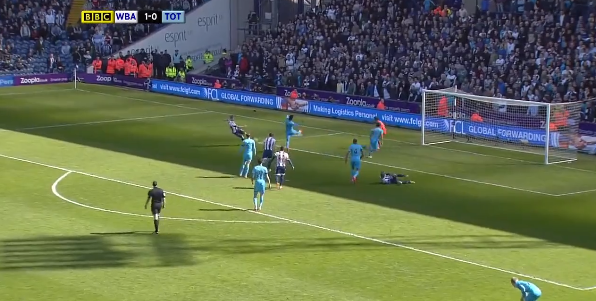
Both full backs had a disaster. Within twenty seconds, Danny Rose – who had his worst game in a Spurs shirt – committed himself in the corner, and missed the ball and the man. Morgan Amalfitano wriggled clear and sent in a cross which Spurs half-cleared, and Matěj Vydra finished well.

Just a few minutes later, Brunt pressed high and decisively on Kyle Naughton, won the ball and was instantly joined by a swarm of teammates. As the ball was switched to the right, Christian Eriksen missed an opportunity to clear. Then, he and Rose could not prevent a cross coming in, and the defence was utterly disorganised in the centre.

1

With Naughton coming into the centre to pick up danger men, Aaron Lennon simply has to come back to cover…

2

…but instead he is not even in shot when the unmarked Chris Brunt slams home a lovely volley at the back post.

How do you play against teams that start games like this? Stay compact. Get bodies behind the ball. Use your wide men to protect your full backs. Do not dive into challenges. Feel your way into the game. Did we do any of these? No. In fact, we went one step further for the third goal as we left Stéphane Sessègnon one-on-one with Vlad Chiricheș – a suicidal move even when chasing a game.

We played well for long periods, dominated and probably created enough chances to win two games, but we ended up taking just a point. So I say to you, Tim: make me your Opposition Scout – make anyone your opposition scout – and make sure the team are prepared for the remaining games.

Breaking down Spurs’ attacks

Rather than focus on some of the shambolic defending that we witnessed from our team on Sunday, I wanted to look at another area in which I found myself very disappointed.

Despite being one goal and then two goals down relatively quickly due to individual errors, we managed to find our creative players in some good areas. However, a lack of movement around them allied with some poor decision-making meant that a number of good opportunities were passed up.

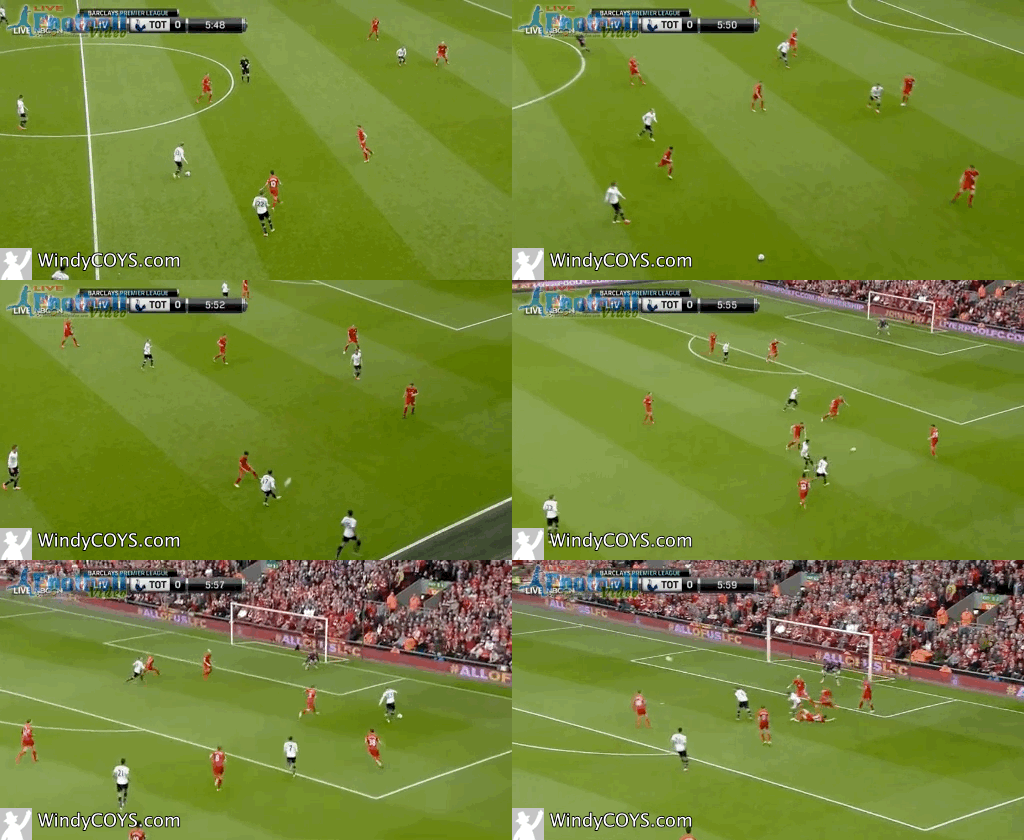
At 1-0 down, after 5 minutes or so, Christian Eriksen receives the ball and plays it square to Aaron Lennon. He continues his run in behind Daniel Agger and receives a clever pass from Nacer Chadli. Note Roberto Soldado, though: he is totally caught on his heels, and fails to make himself a viable option for Eriksen to pick out. Lennon is the only other player that gets into the box, but the angle he creates for the pass is narrowed by Flanagan, meaning that Eriksen’s cross has to be perfect – it isn’t, and is instead cleared.

EriksenCross

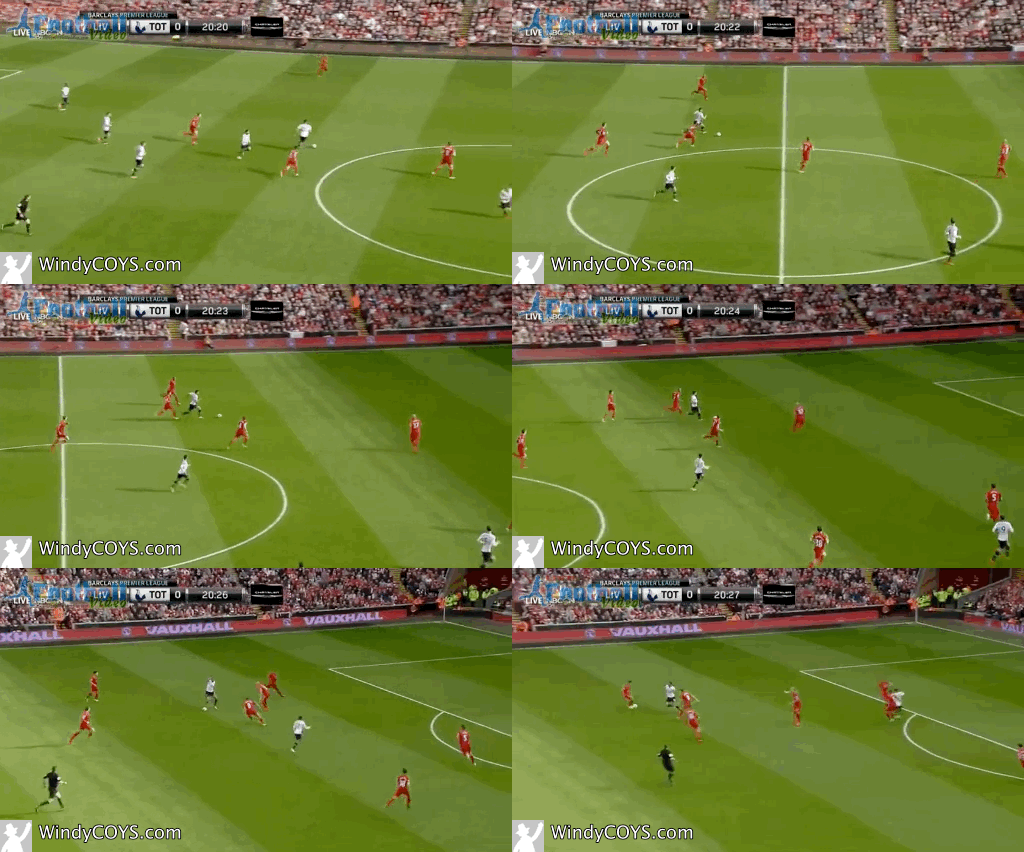
On 20 minutes, Chadli bursts past a couple of Liverpool players into a useful pocket of space. Lennon initially runs away from him, and only cottons on when it’s too late that Skrtel is going to have to close the ball. A natural goal scorer would dart into the gap that Skrtel’s going to inevitably leave far sooner and at maximum pace; Lennon does not score many goals, and this is a good example of why. Chadli is forced to check and has just the one option. His decision to try to force the pass is a poor one – instead he should probably hold the ball up and wait for support, but he was not helped by Lennon’s poor movement.

ChadliBurst

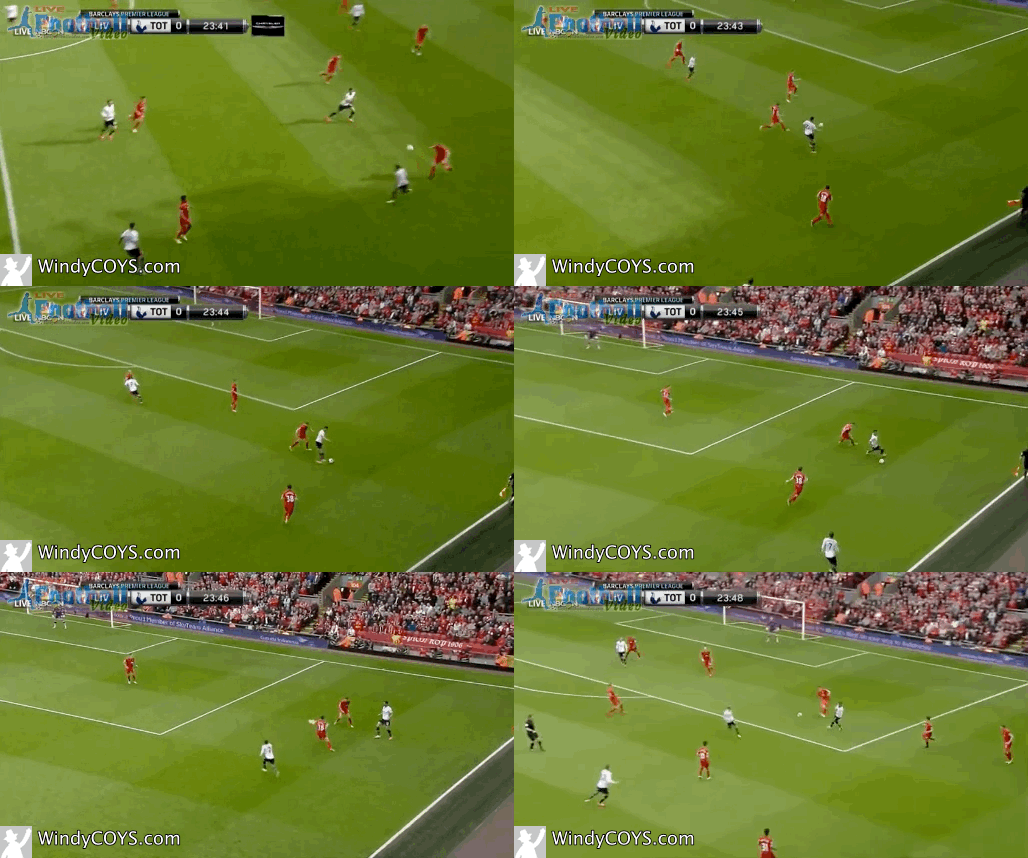
Just prior to the second goal, Chadli gets down the right and initially does well to hold the ball up and protect it from Gerrard. Lennon gets forward in support and makes a run inside Flanagan. Chadli’s pass, though, is terribly loose and he wastes another opportunity to create. What’s more frustrating is that Liverpool score just seconds later, after Dawson’s error.

ChadliBeforeGoal

Eriksen has a great chance to pull a goal back just after Liverpool have taken the lead. Naughton forces his way into the box, and cuts the ball back. It’s hit hard at Eriksen, but his first touch is immaculate. His second, though, is a poor one – his strike is straight at Skrtel when he would probably have been better off curling the ball towards the near post. However, he’s once again not helped by the movement around him – he needs support on the outside, either from Chadli or from Rose, but there’s nothing forthcoming on that side.

Eriksen Chance

Naughton’s desperately wasteful shot just minutes later is just one example of how bad his use of the ball is in the final third. Lennon’s free to his right via a simple pass and they can create an overload in this area relatively simply, but instead he decides to take on a stupidly ambitious shot, and hits the first man.

NaughtonShot

Chadli, Naughton and Sigurdsson create a nice triangle and give Chadli the opposition to set Lennon free one-on-one against Flanagan. Instead, Chadli attempts an elaborate pass for Soldado, who has really made the run to create space for Lennon, rather than receive a pass.

ChadliPass

Seconds later, Eriksen receives the ball between the line but a lack of intelligent movement around him means his options are limited, and his attempted pass is easily cleared.

EriksenPass

A neat move in the 40th minute sees Rose set free down the left after an intelligent reverse pass from Sigurdsson. Sigurdsson and Lennon are the only players who really bust a gut to get into the box though, with Eriksen dallying on the edge of the box and Soldado barely keeping up with play. The ball eventually comes to Soldado who, with team-mates up in support, tries an overly ambitious curler.

RoseCross

Spurs had plenty of possession in useful territories in the first half without benefitting, and it just felt that there was a lack of belief or attacking cohesion. Having gone 1-0 down against one of the most in-form teams in Europe, this was probably understandable. Could this be due to a lack of attacking game-plan, with a reliance on players to just go out, express themselves, and make their own decisions?

Walker missing didn’t help, either – his constant runs forward on the right generally mean that the opposition full-back has another threat to consider, and can open up space for others. Naughton, on the other hand, does not venture forward as regularly.

More brave running, more intelligent passing, and better decisions could easily have brought us back into this game, despite our suicidal defending.

It’s not all bad

After getting a few things off my chest yesterday, I wanted to breathe some positive vibes onto the front page of the blog.

The good news is that, despite the incohesive fan-base, the lack of strategic vision from the top of our club, and significant issues within our first team coaching staff, there are reasons to be cheerful.

On Friday night I watched an Under-21 side comprehensively beat Arsenal. Some of those involved were playing well above their age level, and the performance was encouraging (and, in truth, it could have been 4-0).

Then, on Saturday morning, I saw our Under-18s put in a controlled performance away at Liverpool to record a 1-0 victory. This group of Under-18 players (including Onomah, Miller, Oduwa, Ogilvie and Winks, none of whom played in this match) are without doubt the best I’ve seen over the past decade. And supposedly we have more hot prospects ready to step up next season too.

The first team squad has been a bit of a shambles at times this season, but some intelligent player recruitment and an experienced managerial appointment could quickly turn things around. Contrary to the belief of some, we do have plenty of talent at our disposal, and the new signings will no doubt find their second season far easier.

And, of course, we have 1882. Another brilliant night on Friday showed why 1882 is the envy of other clubs. This season, 1882 has been a beacon of light and the 1882 matches have been by far my most enjoyable experiences of being a fan.

COYS

Toxic Tottenham

I saw a tweet earlier saying that Sherwood is toxic for our club. He isn’t, but the current ill feeling certainly is, and something has to change.

Sherwood has to go. Not because he’ll never be good enough (we’ll never know if he will or not), but because the fans have not and will not take to him. To achieve success, the club needs the fans onside and the majority are patently not – nor will they ever be with Sherwood at the helm (rightly or wrongly).

Predicting that a Spurs manager will fail is not the boldest of predictions; arguably they all have to varying extents since Burkinshaw in the early 80s, aside from a couple of cup wins. Jumping up and down at every questionable decision that the current incumbent makes, and then celebrating ‘being right’ when he inevitably does fail is not, in my opinion, the role of a fan. Instead why not be open-minded and try to create a more positive environment for our players to play in? Criticise, of course, when it’s due – heck, there have been some abominations under Sherwood – but try to be broadly supportive. That’s my position, and that’s why I’m willing to give him a chance until he does something damaging to our club’s reputation, as with Redknapp and the England manager’s job.

I’ve been accused this season of being a Tim Sherwood apologist, much like I was accused before that of being an André Villas-Boas apologist. I’m not, of course, but I am a ‘new manager’ apologist. I have no particular love for Sherwood – I didn’t admire him as a player, and he’s not ‘my cup of tea’ (using his words) as a person. But I could see traces of logic behind his appointment (especially from a continuity POV) and I think the mitigating circumstances surrounding his tenure mean he should be given more leeway from our fans, who are as divided and angry as I ever remember.

For anyone coming in to take over after the final few thrashings under AVB, it was a tough job. We had an under-performing squad with a lot of new players who hadn’t shown signs of settling in any time soon. We’ve also had (surprise, surprise, we’re Tottenham), a ludicrous number of recent injury concerns.

The vitriol towards Sherwood has been far worse than it probably would have been for anyone else. Probably because he’s a Gooner, probably because he’s got an accent which reminds people of the many uncomfortable Harry Redknapp press conferences and interviews and probably because he is, quite literally, unqualified for the job.

Sherwood’s job has, of course, also been made more difficult by the fact that he has no prior experience of managing a football club, and so was always going to be learning as he went along. And he has, sometimes, showed signs of learning: adapting from a 4-4-2 to playing with one forward when necessary, for example, or changing things at half-time against Southampton to ensure we pressed the ball to complement the high line.

Today against Liverpool his hand was forced. Missing our two best players this season – Adebayor and Walker – as well as Chiriches, Capoue, Lamela, and Paulinho and with Sandro (who has been playing with painkilling injections) and Dembele (who looked so unfit last week) seemingly not fit to start, he was “down to the bare bones” and even had to include rookie Harry Winks on the bench. His team selection looked gung-ho on initial inspection, before you realised that – short of going three at the back with Dawson brought into the side – he had few other options.

Add to that that his game-plan – “stay in the game for as long as possible and hopefully it will open up for us later on” – was out the window after just over a minute, mostly due to individual errors.

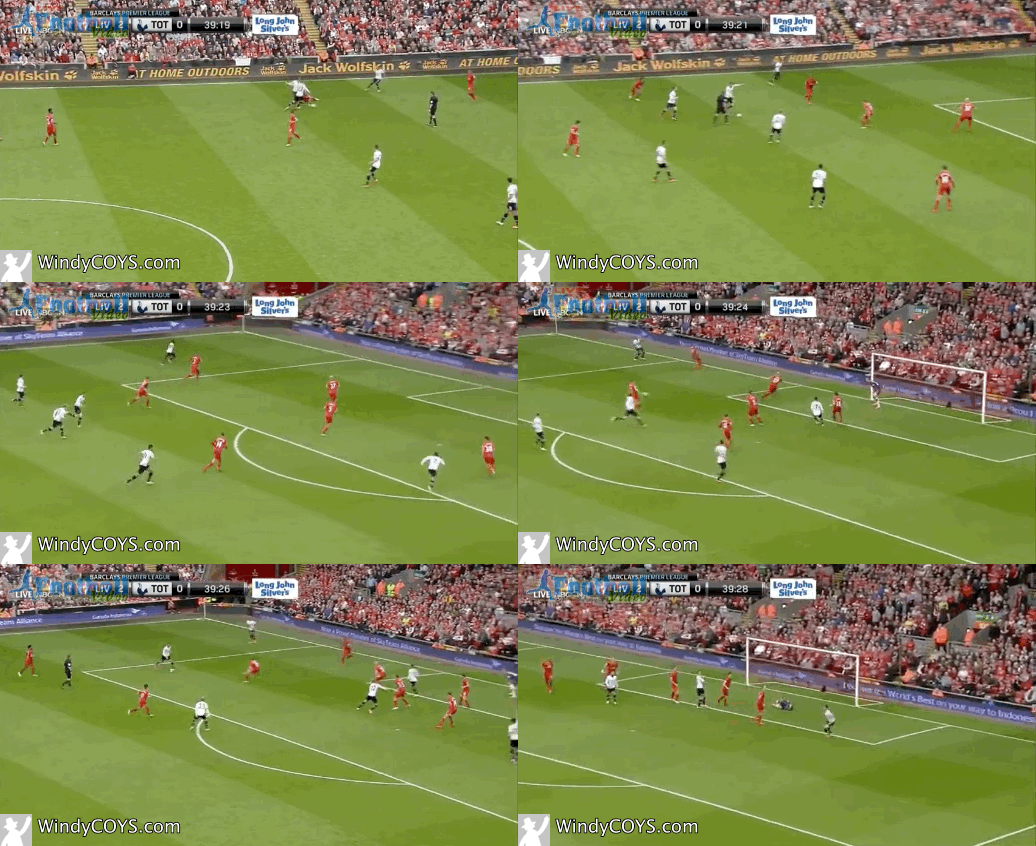
Sherwood’s been criticised for playing Eriksen wide on the left, but mostly because people feel he’s less effective offensively there. Today, though, he showed his defensive frailty in the first minute. Of course, Sherwood could have opted for a slightly more defensive player on the left to combat Johnson’s runs, but a man with the experience and intelligence of Eriksen should be able to track a fairly obvious run and to stop a cross coming in. Vertonghen scuffed his clearance, the ball awkwardly ricocheted into Kaboul’s instep, and Sherwood needed to think again. It was 2-0 when Dawson played a sloppy pass and then couldn’t catch Suarez.

But here’s where Sherwood could do more. For the rest of the half, our approach play was reasonable and we managed to give both Eriksen and Chadli the ball between the lines, only for them to waste opportunities to create. He didn’t change anything, though, to improve upon this – no personnel changes, no tweaks. And, before long, Liverpool snuffed out any opportunities we did have, restricting our creative players and stopping them from receiving the ball in the areas they had been in the first half.

Then came goal three; Lennon didn’t chase Flanagan back, meaning Bentaleb had to close the ball, leaving Coutinho in space to receive it and get a shot away. We defended too deep at the set piece from which goal four stemmed; Sherwood could be accused of not organising his troops for these situations, but the players need to more accountable for all four goals today.

But I digress from my central point, which is that whilst I don’t think Sherwood is an ideal management candidate, he is our manager (Head Coach), and yet another change does not guarantee improvement. Managers and coaches need time to work with their squads and develop a pattern of play, a defensive structure – an identity. This is why I’ve not wanted to judge our coach too soon; to write him off.

Brendan Rodgers was widely-derided last season, as was one of his favourites, Jordan Henderson. Yet this season he has Liverpool organised, motivated and, importantly, confident. Henderson’s been exceptional and will likely start for England in the World Cup. It might be wrong to compare Sherwood and Rodgers, since Rodgers had four years of managerial experience (including another Premier League job) before taking on his role at Liverpool, but they do share youth coaching backgrounds. Sticking with Rodgers, investing in his player choices, and giving him room to implement his ideas has worked wonders.

Divided since Redknapp’s sacking, the only move that would seem to unify our fan-base is the appointment of someone who seemed previously totally unattainable – Louis van Gaal. And, thus, the revolving manager-door continues.